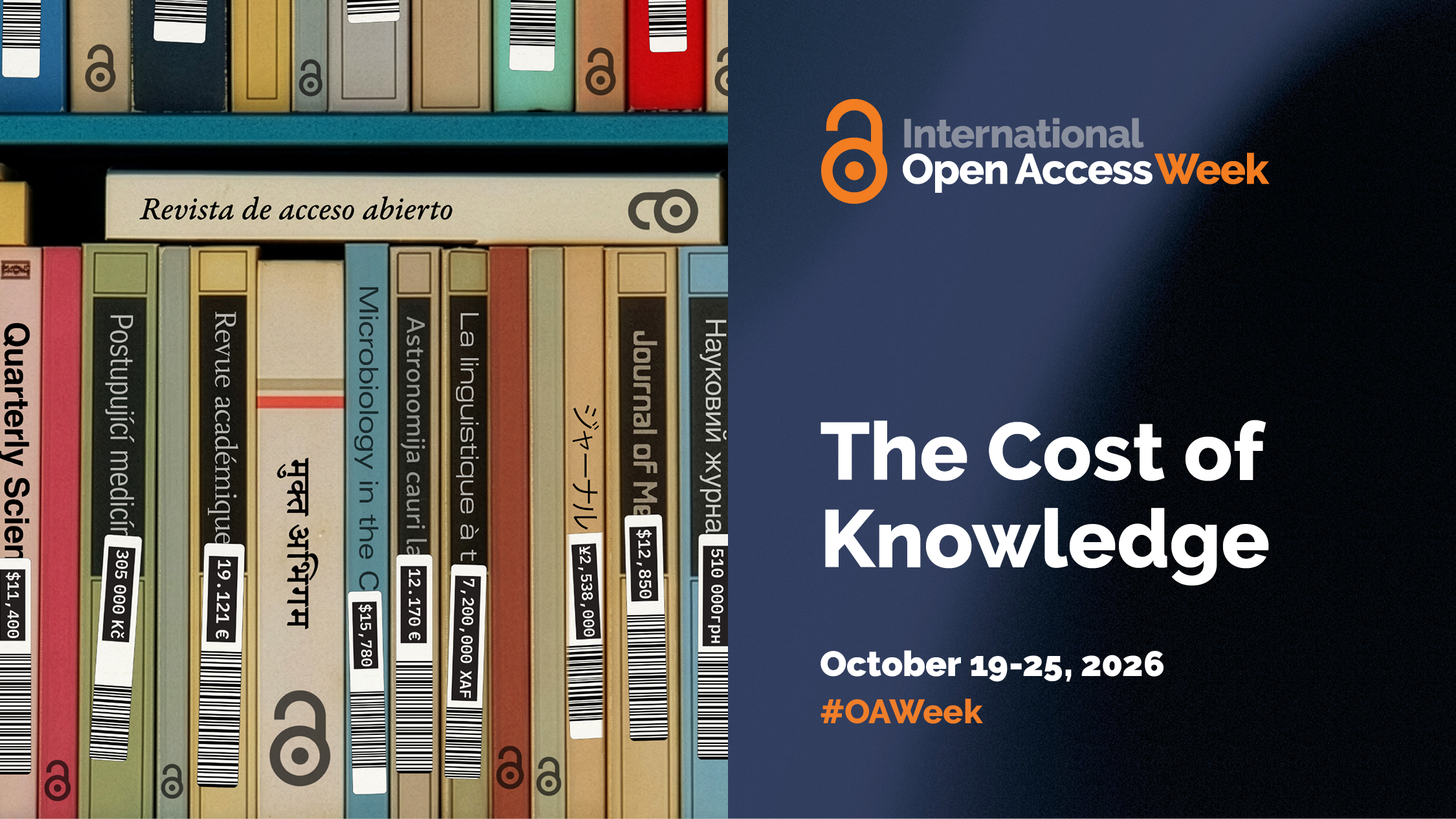
As Coalition Publica considers this year’s International Open Access Week theme, “The Cost of Knowledge”, we reflect on how diamond open access is often evaluated against commercial publishing models, as though removing market-based profit motives represents a weaker or less viable economic approach to scholarly communications. In reality, diamond open access reflects an economic model based on fundamentally different metrics in the service of collective investment, long-term sustainability, and retaining value within scholarly communities.
Rather than extracting value from academic systems, diamond open access supports the development of shared infrastructures and maintains the link between the benefits of knowledge creation and the communities that produce it. When we think about the cost of knowledge, we need to consider the cost to society as a whole when we put profits before advancing understanding, informing decisions, and improving human conditions.
For many scholars, the economics and power structures of scholarly communication were simply inherited rather than questioned. One of the opportunities that diamond open access creates is the chance for researchers and practitioners to engage critically with the systems that shape scholarly publishing.
Below, we invite Monica Ward, Head of Collections Strategy at the University of Ottawa Library, and Sally Sax, Head of Collection Strategy and Partnerships at Carleton University, to join a conversation about the cost of knowledge.
- Most people recognize that producing high-quality scholarship requires diverse forms of investment. Increasingly, however, stakeholders also want to understand the value that these investments create. In your work, what factors shape your understanding of value when deciding where to invest in scholarly communication systems and infrastructure?
Monica Ward (MW) – When looking at value, we often default to quantifiable elements, like cost or usage statistics, but some of the value that comes out of investing in community-built systems and infrastructure is more nuanced. We need to see if it aligns with the library’s vision, mission, and goals and we need to look more broadly at impacts, rather than just metrics. For example, although we can attach a number to how many papers are published OA, the actual value is that more people can access and use and share the research. That’s not something to which you can attach a dollar figure.
At least in a non-commercial model, we can value knowledge in and of itself, and it doesn’t necessarily have to be tied back into a number. Because knowledge has been commodified, we’ve fallen into the habit of just assessing value as a financial metric and that doesn’t always work well for long term investments in systems and infrastructure.
Sally Sax (SS) – As Monica said, we’re expected to explain value in terms of measurable outcomes. The value of scholarship is immeasurable because it’s future-focused; it creates all kinds of possibilities without guarantees. Scholarship is hard work; using the library’s digital collection shouldn’t be an additional source of friction in the research process. But in the commercial information environment, we end up paying for hundreds of different licenses that govern the use of digital collections. The terms and conditions of those licenses can impose restrictions on the way research is done. This adds risk and complexity to the research process, and slows things down.
There is enormous value to be gained from libraries investing in systems and infrastructure that make digital information less risky and burdensome for the researcher to use. When I think about investment, I’m thinking about what will contribute to a stable information environment that facilitates the pursuit of knowledge, and minimizes friction for researchers.
- When we think about the cost of knowledge, we also need to consider the costs of the systems we are currently choosing to support including the long-term implications of relying on commercial actors that not only shape the production, distribution, and ownership of scholarly knowledge, but also draw substantial financial resources out of the academy. How do you think about the long-term impacts of where financial resources are directed within the academic publishing ecosystem?
MW – Short-term, many of these commercial arrangements seem fine. They meet the needs of the researchers to have access to content, but it’s built on the assumption that commercial providers own the content, and we must buy it back from them. As long as we stay in the short-term mindset, then commercial providers will continue to control the scholarly publishing system. So much of the academy’s financial resources are tied up in the commercial model, unless we make investments now in other options, that’s not likely to change.
With commercial providers it feels a bit like money going into a black hole. We continue to put more money in each year, and we don’t really see anything grow or change. Whereas with other initiatives, we can actually see something being built that’s more long-term and that’s actually trying to serve the research enterprise.
SS – Publishers are no longer just the library’s suppliers, they’re the library’s competitors. Libraries used to be uniquely positioned to provide information as a service, but the shift to digital means publishers can offer their proprietary information as a service through their own platforms. Those platforms are then licensed to libraries under terms that favour the publisher’s interests. The long-term impact of libraries being forced to rent publisher-controlled collections for the past thirty years has been a loss of institutional autonomy. I think that’s had a negative impact on what we think a library exists to do, and how we think a library’s collection budget should be spent. We’re forced to spend the collection budget efficiently as opposed to investing it wisely.
We can’t guarantee long-term access to content or that commercial actors will permit researchers to use content the way they need to under this business model. Researchers don’t have true academic or intellectual freedom with licensed content; they have permissions, and those permissions can be revoked. Complex and longer-term research is especially vulnerable, and there’s an increasing risk of projects being modified, simplified, or abandoned as access rights change or become unaffordable.
- Where do you see the greatest opportunities for libraries and librarians to influence where resources flow and whose labour is recognized in the systems that support knowledge creation?
MW – Our main lever is the collections budget, and how we spend it. The issue is that how we spend our budget is greatly constrained by choices authors make about where to publish and what content they want to read and use in their research and teaching. And those choices are constrained by the promotion and tenure system, which rewards publishing in certain venues more than others. Much of that is out of the control of the library, but we do have some agency to support different kinds of initiatives within our budget, it’s just limited by how much money we are already spending on more traditional arrangements with big publishers.
SS – It’s true we can’t control what the faculty wants us to buy or the structure of the tenure system. But I also think librarians focus a lot on faculty’s reluctance to change their part of the system. We need to critically assess our own operations. We do more than spend money, and our work has a significant impact on the research ecosystem.
For example, the licensing we do to provide access to digital content is inherently disadvantageous to libraries and researchers. The only thing you negotiate in a true purchase is price. When you license a database, you have to negotiate every aspect of the library’s operations and the kinds of services the library is allowed to offer with the vendor’s content, like inter-library loan. How can we enter into fair negotiations when our vendors have a monopoly on the commodities we need in order to fulfill our service mission?
We need to challenge our own status quo if we’re going to convince faculty to challenge their status quo. I think librarians will be more compelling advocates for change if we speak to library-specific struggles and how we’re forced to do business in the current system.
- What benefits do you associate with scholarly communication infrastructure that is governed and sustained by scholars, libraries, and academic communities versus those of for-profit publishers?
MW – There are many opportunities to broaden access and do more with research content. There are innovations, be that in new ways of doing research using artificial intelligence, or starting new programs for non-traditional students, or new approaches to resource sharing, that we cannot undertake right now because of restrictions on the use of library resources, restrictions that are put in place because the content is partially controlled by commercial entities. Even when we purchase digital resources, they are often governed by a license agreement that restricts what can be done with it.
If you work with a scholarly communications infrastructure that is governed and sustained by academic communities and want to try something innovative, there’s generally a shared goal of advancing research and learning. There may be costs, but they represent the actual costs of the work involved, not the market value determined by the vendor.
SS – I think a major benefit of managing the infrastructure is owning the work. Librarians are developing new types of expertise through their contributions and will hopefully attract a diversity of people with the skills to fulfill new roles as our participation in that work increases.
Canada has some very productive organizations managing infrastructure that operate on a fraction of what we’re paying commercial actors to rent access to their infrastructure. Owning the infrastructure also means supporting and sustaining local jobs and talent. It’s an efficient use of public funds and contributes to the overall health of the economy and information sovereignty. The larger benefits of sustaining our own scholarly communications infrastructure extend beyond the academic community.
- What opportunities are missed by not reinvesting in community-driven models such as diamond open access? How do investment decisions in scholarly communication affect who ultimately benefits from publicly funded research?
MW – It’s always a question of what else could the research community be doing with the money if so much wasn’t tied up in agreements with commercial vendors. What research projects could be better funded? What extra research grants could be offered? What restrictions are we accepting because the commercial model is still the dominant model?
If we look at the bigger picture, keeping research outputs in the control of commercial entities could mean that those associated with large, well-funded institutions, continue to be the main beneficiaries of publicly funded research as they are the ones who can afford to participate in costly agreements.
SS – The point of investment is to build wealth. Wealth sustains the institutions responsible for delivering public services over the long-term, and the source of the library’s wealth is information. That’s why we’re here, to share our wealth of information! We should own and manage digital content and infrastructure in the same way we own physical collections and the buildings that house them. Our lack of digital ownership rights means we’re thirty years behind where we should be in the evolution of how we deliver library services across all formats.
If we don’t invest in community-driven models, we’re missing an opportunity to catch up, regain our footing, and start to plan further ahead. This is how a future-focused institution should operate, but we’re too busy working in constant crisis mode to do that under the current system. We’ll keep falling behind if we don’t invest in our own community. That will only benefit those who measure information’s value against how much it sells for, and not against the quality of the ideas scholars are trying to share with the world.
Monica Ward is the Head of Collections Strategy at the University of Ottawa Library, overseeing teams responsible for collection development, acquisitions, interlibrary loan, and the library’s off-site storage facility.
Sally Sax has twenty years of experience overseeing the development, acquisition, and licensing of research library collections. She is the Head of Collection Strategy and Partnerships at Carleton University and previously managed the Resource Selection and Acquisition team at Canada’s Library of Parliament.