
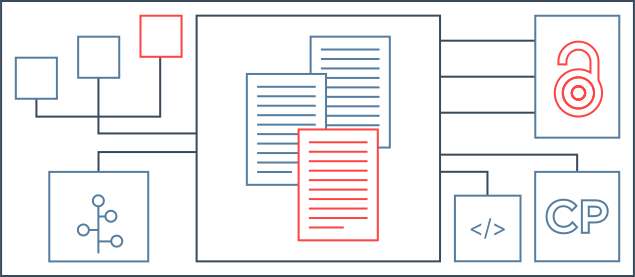
Coalition Publica connects Open Journal Systems (OJS) and the erudit.org platform to benefit Canadian scholarly journals. But it's more than just technology - by joining Coalition Publica, journals become part of a global effort to build a sustainable alternative to commercial academic publishing.

Making diamond open access a reality for Canadian journals
Coalition Publica works to make diamond open access a realistic option for Canadian scholarly journals. Participating journals benefit from wide dissemination on the erudit.org platform, using OJS for journal operations to streamline editorial and publication workflows. Importantly, journals on the erudit.org platform receive funding from the Partnership for Open Access, a collaborative funding model backed by libraries and the research community.
Benefits of joining Coalition Publica
- Funding and workflow tools to support sustainable and equitable open access.
- Wide reach via a central discovery platform used globally by researchers and practitioners.
- Personalized support and connection to Canada’s diamond open access community.
- Tools and services to measure reach, align with standards, build trust, and preserve published content.
- Journal content is added to our textual data corpus, furthering research and scholarship in the social sciences and humanities.
Financial support for open access

A pillar of Coalition Publica, the Partnership for Open Access (POA) enables open access publishing in Canada by funding non-commercial scholarly journals on the erudit.org platform. Backed by committed library partners and in close collaboration between all stakeholders of the research ecosystem, it promotes collective, equitable, and robust knowledge sharing. Journals can generally recover costs through the support offered by the POA which is designed to be a sustainable, revenue-generating model within the diamond open access movement.
Join Coalition Publica
Your journal is using OJS
Your journal is on Érudit
Your journal is not using OJS nor on Érudit
If your journal is using OJS
Consider applying for inclusion on the erudit.org platform to take advantage of its dissemination and editorial support services, tailored to your unique needs. Since its launch in 2017, Coalition Publica has welcomed over a hundred Canadian scholarly journals in the social sciences and humanities to Érudit. When you join Coalition Publica, you can either keep your current OJS hosting arrangement or we can put you in touch with a hosting solution tailored to your needs.
Keep all the benefits of OJS and gain:
- Wider dissemination, greater visibility, and higher impact.
- Financial support through the Partnership for Open Access.
- Long-term preservation with Portico and Scholars Portal.
- Expert advice on creating quality metadata to increase your visibility.
If your journal is already on Érudit
Consider adopting Open Journal Systems, a powerful, open-source platform that facilitates every step of scholarly journal publishing from submission and peer review to editing, publication and preservation. We can connect you with service providers to help you run your journal on OJS, either via our own PKP Publishing Services, or via one of our Canadian library publishing partners.
Keep all the benefits of being on Érudit and gain:
- Tools to manage your editorial workflow, automate reminders, collaborate with your team, and publish content easily.
- Seamless automatic integration with Érudit lowering your production costs and reducing your administrative tasks.
- Flexibility with new publishing models like online first and early view, continuous publication, multimedia, and more
- Additional long term archiving and contribution to the research lifecycle via the PKP Preservation Network (LOCKSS) and the PKP Beacon.
Not yet using OJS nor on Érudit?
If you manage a Canadian scholarly journal, Coalition Publica offers an affordable, full-service publishing solution—from submission to preservation. We invite you to explore what OJS and Erudit both offer and to consider us for your publishing operations.
All Coalition Publica journals benefit from:
- Flexible publishing options via OJS, an open-source software designed to manage the full editorial workflow.
- A connection via OJS to Érudit’s centralized platform for wider dissemination and greater visibility.
- Financial support through the Partnership for Open Access, a library-backed collaborative funding model that supports Canadian scholarly journals.
- Support from a professional team to enhance your metadata, make best use of persistent identifiers, and get indexed in the Directory of Open Access Journals.
- Long term preservation via Scholars Portal, Portico and PKP Preservation Network.
Working for you with community partners
Coalition Publica works with Canadian library publishing partners and key players in international scholarly publishing to create and share educational and training materials tailored to journal editors. From hands-on guidance to insights on the evolving world of scholarly communication and open access, we’re here to help editors stay informed and equipped for the future of publishing.
- Flipping journals to diamond open access
- Our experienced team has worked with over forty journals to flip their publishing model
- Improving metadata quality
-
We work with you and offer guidance to improve metadata quality, which is essential for consistent online discoverability, visibility and indexing.
-
- Applying to the DOAJ
- The Coalition Publica team has strategic and operational partnerships with the Directory of Open Access Journals and works with library publishing and hosting services to support open access journals in the application process
- Adoption of persistent identifiers
- We help you make sense of article, author and institutional identifiers so you can connect your journal to the global network of interoperable data points that make your work discoverable, permanently.
- Scholarly publishing in Canada
- We research and publish data about the Canadian journal landscape so that you can situate yourself in this diverse community.
From our journal partners
Coalition Publica is a critical node that bridges infrastructure, knowledge, and know-how to foster successful Diamond Open Access for journals. With their transparent operations and collaborative spirit, Coalition Publica’s advocacy and network mobilization has supported many of our members in their work to create impactful Diamond Open Access journals. We have been privileged to work alongside Coalition Publica on webinars and information sessions for our membership, and that has always been not only productive but also energizing. Coalition Publica has been—and will no doubt continue to be—essential to the wellbeing of a diverse and influential journals ecosystem in Canada.
Dr Jess Herdman
Executive Director, CALJ
Coalition Publica is having a remarkable impact on scholarly publishing in Canada. At Iter Press, our journals benefit tremendously from Public Knowledge Project’s Open Journal System and Érudit’s professional marketing, distribution, and archiving systems, all together allowing the press and our journal editorial teams to focus on the development of academic content.
That Coalition Publica has launched a successful campaign for diamond open access is a testament to their vision and effectiveness, for which we are grateful.
William R. Bowen
Editor-in-Chief, Iter Press

Ontario History journal, published by The Ontario Historical Society, congratulates Coalition Publica on the launch of their new website. Working with Coalition Publica, the readership of our journal, both domestic and international, disseminated on the Érudit platform, has grown exponentially. We commend Coalition Publica's important work and thank them for their support, which enabled us to transition to an open access journal in a sustainable manner. Furthermore, we are grateful for Coalition Publica's crucial educational assistance as Ontario History moves towards diamond open access.
Sarah McCabe
Project Manager and Librarian,
The Ontario Historical Society
The Ontario Historical Society
Coalition Publica provides scholarly journal teams an infrastructure that facilitates their day-to-day work. Journals also benefit from the Partnership for Open Access (POA) which gives them the opportunity to increase and diversify their funding sources, while helping to establish a sustainable and equitable model for knowledge dissemination. A driving force behind the development of open access in Quebec and Canada, the POA perfectly embodies its spirit, bringing together various players in the publishing community to promote the development of a more equitable, diversified, accessible and robust science. Coalition Publica is therefore an invaluable ally of the Réseau Circé.
Francis Gingras
Chief Executive Officer, Réseau Circé

Resources
Our resources section is developed with our community partners.
Have a resource to recommend?
Have a resource to recommend?
Roadmap for SSHRC Aid to Scholarly Journals: Adopting Best Practices in Diamond Open Access
This road map is meant primarily for scholarly journals, with or without an embargo period/moving wall, that do not already use an open licence and that intend to comply with the criteria laid out in the 2025 SSHRC ASJ program, though any journal may find its guiding principles useful.
French translation of the DOAJ documentation
Here you will find the French translation of the documentation for inclusion in the Directory of Open Access Journals (DOAJ).
DOAJ Application Guide
This guide provides guidance for journals using Open Journal Systems (OJS) on how to represent and link to information in OJS that is relevant for Directory of Open Access Journals (DOAJ) inclusion and the DOAJ application.
Journal Policies and Workflows
This guide provides an overview of common journal policies and workflows and how they can be applied within OJS. Relevant documentation is linked throughout the document to instruct on how these practices can be employed in OJS.